
EU Taxonomy KPI Report
CEZ Group has reported key performance indicators pursuant to the classification of activities in accordance with EU Regulation 2020/852, other taxonomy regulations, and related delegated acts (the EU taxonomy).
The EU taxonomy imposes reporting obligations, or disclosure of key performance indicators (KPIs) associated with sustainable activities, and compliance of economic activities in relation to the six applicable environmental objectives.
CEZ Group‘s activities in the energy sector and in energy services are primarily focused on significantly contributing to climate change mitigation (CCM). The share of the economic activities in relation to the objectives Circular Economy (CE) and Water and Marine Resources (WTR) within the KPIs is insignificant, and activities in relation to the WTR goal are classified as Not assessed activities. These aligned activities are closely linked to the Climate Change, Pollution, and Water Resources chapters of this Report. Economic activities focused on Climate Change Adaptation (CCA), Pollution Prevention and Control (PPC), and Biodiversity and Ecosystems Protection (BIO) are not represented in CEZ Group‘s portfolio of activities for 2025. CEZ Group implements actions to ensure climate protection goals and other key sustainability topics within its core activities.
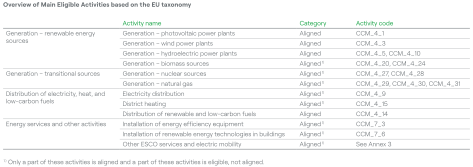
The reporting and criteria assessment process was carried out by collecting data and information across fully consolidated companies in CEZ Group, at the level of individual economic activities. CEZ Group discloses eligibility and alignment of its own economic activities in line with legal requirements. Alignment of all eligible activities is assessed based on technical screening criteria. The technical screening criteria consist of a set of substantial contribution criteria for each eligible activity for the relevant environmental objective (mainly CCM) and a set of DNSH (Do No Significant Harm) criteria for the other five environmental objectives. The alignment is typically assessed at the level of individual activities or projects of a given company. The requirement to assess climate-related risks and compliance with the requirement for minimum social safeguards are criteria with a group significance across all activities, and are therefore assessed at the CEZ Group level.
The DNSH criterion for adaptation to physical climate-related risks has general applicability for all CEZ Group activities and is of group-level importance. In 2025, CEZ Group updated and expanded the scenario analysis in cooperation with the CRIF platform. Within CEZ Group, material but unmanaged climate-related risks occur only at locations with less significant activities that are not related to the main energy operations. These activities, for which it was not possible to verify the readiness of mitigation procedures or the implementation of adaptation measures, are reported as eligible, not aligned. These are activities associated primarily with the risk of floods. The scenario analysis is described in the chapter Climate-related Risk Analyses of this Report.
In accordance with Commission Delegated Regulation (EU) 2026/73, there are two main changes to the EU taxonomy reporting compared to 2024. The first change is the use of updated templates for publishing KPIs (Template 1 and Template 2). The second change is the reporting of the category of Not assessed activities considered non-material. In the 2025 report, CEZ Group exercised the option under Commission Delegated Regulation (EU) 2026/73, whereby non-financial undertakings may waive the assessment of whether some of their economic activities are taxonomy-eligible or taxonomy-aligned for a key performance indicator, if the cumulative value of the indicator resulting from these economic activities is lower than 10% of the denominator of the key performance indicator. When selecting activities within this category, CEZ Group assessed its financial materiality in the preceding period, relevance to CEZ Group‘s key business, strategic, and development activities, and whether those activities were outside the main business sector – energy. The activities included are not related to CEZ Group‘s main economic activities and sectors and are not material from the perspective of the operating segments (these are functionally independent parts that form partial process components of the CEZ Group‘s value chain). The Not assessed category includes activities both within and outside the potential scope of the EU taxonomy, which are not activities that cause significant harm to the environment. The sectors and activities included are mainly financially non-material activities in forestry, water supply, waste management, road freight transport, data processing and hosting, and building demolition. Further included are activities of companies in phase-out or liquidation as well as non-material, irregular, or supplementary activities of individual CEZ Group companies.
CEZ Group ensures full compliance with the minimum social safeguards and conducts its business in accordance with human rights and ethical principles and standards. CEZ Group adheres to fundamental international conventions and fully complies with international conventions and declarations on human and labor rights and takes them into full consideration when developing ethical commitments and rules.
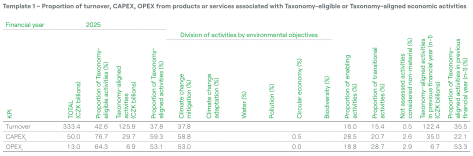
In accordance with the European Commission’s guidelines, the values for 2024 presented in this template correspond to the reported values of the KPIs prior to the change of methodology based on (EU) 2026/73. The values for 2024 presented in the tables below have been recalculated for comparability.
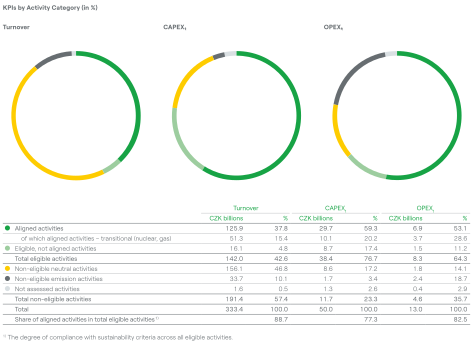
| 20241) | 2025 | |||||
|---|---|---|---|---|---|---|
| Aligned | Eligible, not aligned | Non-eligible | Aligned | Eligible, not aligned | Non-eligible | |
| Generation – renewable energy sources | 20.3 | 0.4 | - | 16.8 | 0.4 | - |
| Generation – transitional sources | 44.1 | 6.1 | - | 51.3 | 5.5 | - |
| Distribution of electricity, heat, and low-carbon fuels | 50.8 | 0.8 | - | 52.4 | 0.5 | - |
| Energy services and other eligible activities | 7.0 | 9.7 | - | 5.4 | 9.7 | - |
| Non-eligible neutral activities | - | - | 164.3 | - | - | 156.1 |
| Non-eligible emission activities | - | - | 40.0 | - | - | 33.7 |
| Not assessed activities | - | - | 1.2 | - | - | 1.6 |
1) The values for 2024 are recalculated to reflect the category of Not assessed activities for comparability.
The share of CEZ Group’s EU taxonomy-aligned revenues is 37.8%. These are mainly revenues from electricity distribution and generation of electricity from nuclear energy. Other important activities include the construction and operation of photovoltaic power plants, the installation of energy-saving equipment, the installation of photovoltaics and heat pumps in buildings, hydropower and heat distribution and supply, and provision of expert energy services.
| 20241) | 2025 | |||||
|---|---|---|---|---|---|---|
| Aligned | Eligible, not aligned | Non-eligible | Aligned | Eligible, not aligned | Non-eligible | |
| Generation – renewable energy sources | 4.4 | 0.0 | - | 2.0 | 0.0 | - |
| Generation – transitional sources | 7.9 | 0.7 | - | 10.1 | 1.7 | - |
| Distribution of electricity, heat, and low-carbon fuels | 21.1 | 0.3 | - | 15.9 | 0.2 | - |
| Energy services and other eligible activities | 1.4 | 2.0 | - | 1.7 | 6.8 | - |
| Non-eligible neutral activities | - | - | 117.7 | - | - | 8.6 |
| Non-eligible emission activities | - | - | 2.5 | - | - | 1.7 |
| Not assessed activities | - | - | 0.4 | - | - | 1.3 |
1) The values for 2024 are recalculated to reflect the category of Not assessed activities for comparability.
In 2025, the one-off material impact of the acquisition of GasNet Group, which affected the EU taxonomy reporting for 2024, ceased. The share of taxonomy-aligned CAPEXt reached 59.3% and the structure of CEZ Group‘s sustainable investments in 2025 is still focused primarily on the modernization and renewal of the electricity network and distribution, with year-over-year decreases in additions to assets in the distribution system due to the drawdown of subsidies. Furthermore, there was a decrease in investments in the construction of PV power plants in connection with the completion of a number of projects; in wind power plants, there was a decrease in investments in French wind parks. Investments in new nuclear power plants decreased due to the sale of Elektrárna Dukovany II. Investments in small modular reactors are still in the preparatory phase and requirements for constructing facilities at locations are being determined within the framework of the EIA. The GasNet Group continued its investments in hydrogen-ready gas pipelines. Investments in transitional aligned activities included primarily investments in the operation of nuclear facilities at existing sites and investments in the transformation of coal-fired sites into combined-cycle gas power plants. There was a year-over-year decrease in investments in coal-fired generation due to the ongoing transformation of coal-fired facilities to low-emission and the sale of Polish coal assets. Investments in coal mining also declined year on year. The circular economy objective is supported by the use of software and licenses within ČEZ Distribuce for the design, monitoring, and maintenance of the distribution grid, its components, and IT systems, and supplier management.
| 20241) | 2025 | |||||
|---|---|---|---|---|---|---|
| Aligned | Eligible, not aligned |
Non-eligible | Aligned | Eligible, not aligned |
Non-eligible | |
| Generation – renewable energy sources | 0.3 | 0.1 | - | 0.3 | 0.1 | - |
| Generation – transitional sources | 3.4 | 0.2 | - | 3.7 | 0.4 | - |
| Distribution of electricity, heat, and low-carbon fuels | 2.5 | 0.3 | - | 2.6 | 0.0 | - |
| Energy services and other eligible activities | 0.4 | 0.8 | - | 0.2 | 1.0 | - |
| Non-eligible neutral activities | - | - | 1.1 | - | - | 1.8 |
| Non-eligible emission activities | - | - | 3.2 | - | - | 2.4 |
| Not assessed activities | - | - | 0.3 | - | - | 0.4 |
1) The values for 2024 are recalculated to reflect the category of Not assessed activities for comparability.
Aligned operating expenses OPEXt account for a share of 53.1%, which is a year-over-year increase taking into account the new category of Not assessed activities. The result mainly includes maintenance and repair costs of aligned nuclear facilities, elektricity and heat distribution infrastructure within efficient systems, as well as operating expenses related to research. Year on year, operating and maintenance costs in the coal‑based energy sector decreased, related to the gradual phase-out and replacement of these facilities and the sale of Polish coal assets. In contrast, maintenance costs of GasNet gas pipelines increased due to the acquisition and inclusion of expenses for only part of the year.
CEZ Group divides its non-eligible activities into two basic categories: non-eligible neutral and non-eligible emission activities. The largest share of non-eligible activities is represented by neutral activities, including, for example, trading and selling commodities (electricity, gas), distribution of natural gas, manufacturing of components and servicing for energy technologies, ICT and telecommunication services, facility management, and other services. CEZ Group also assesses the operation of experimental research nuclear reactors of the Research Center Řež to be a non-eligible neutral activity. The research reactor LVR-15 is used for the production of radioisotopes, conducting irradiation experiments, neutron activation analysis, and performing measurements on neutron beams. Non-eligible emission activities include coal mining and the generation of electricity and heat from coal. Emission activities are activities considered as non-eligible with a direct negative impact on the environment. The impact of these activities on the monitored KPIs decreases over time (more details are provided in the chapter EU Taxonomy Key Performance Indicators of this Report). Investments in the coal-based energy are focused on maintenance and ecologization, or on ensuring the economic viability of operations. These investments are necessary for energy security and adequate heat supply until low-emission and zero-emission sources are in operation. Investments in mining activities are focused on the necessary maintenance and reconstruction of technologies and are in line with the expected lifespan of the existing mining sites. OPEX within non-eligible activities is mainly connected to repair and maintenance of coal-fired power plants and maintenance of mining equipment. The share of non-eligible emission activities will gradually decline in line with the planned coal phase-out at individual sites based on the CEZ Group decarbonization commitments and targets validated under the SBTi.