VISION 2030
Clean Energy of Tomorrow is the answer of CEZ Group to societal request for sustainability. We were searching deep and found real possibilities of how to reach carbon neutrality which is one of the EU top priorities and which is also important for citizens of our country and for ourselves. If there is only a slight chance to generate electrical energy in clean and no-emission manner thanks to modern technologies, it will be necessary to find ways to reach such goal.
The CEZ Group found that way. It updated its long-term strategy and defined actual goals up to 2030 in the areas of environment, social needs, and administration and company management.
In 2021, CEZ Group adopted the strategy VISION 2030 – Clean Energy of Tomorrow (VISION 2030), in which it defined specific ambitious targets and public commitments by 2025 (also by 2030 and 2040) in three areas of sustainable business: Environmental (E), Social (S), and Governance (G). In March 2025, VISION 2030 underwent a partial update with the intention of reflecting the latest changes in the energy sector that had occurred since the beginning of 2022 into specific targets.
Strategic Vision for the Year 2030 – Clean Energy of Tomorrow
The Accelerated Strategy – VISION 2030 consists of two strategic pillars:
- Transform the generation portfolio into a low-emission one and reach climate neutrality.
- Provide the most cost-effective energy solutions and the best customer experience in the market.
These pillars are complemented by ESG commitments – develop CEZ Group in a responsible and sustainable manner in accordance with ESG principles.
Making the future better for all of us.
| Enviromental | Social | Governance |
|---|---|---|
| Reduce CO2e emissions in accordance with the Paris Agreement “well below 2 degrees Celsius” by 2030 (reduction from 0.38 t CO2e/MWh in 2019 to 0.26 in 2025 and below 0.16 in 2030). | Continue to be a decent corporate citizen, cultivating good relationships with communities. | Achieve 30% female representation in management. |
| Reduce the share of electricity generated from coal from 39% in 2019 to 12.5% by 2030. | Maintain the position of an attractive employer for future talents and current employees. | Increase the frequency of employee training in the Code of Conduct – train at least 95% of employees each year. |
| Reduce NOX emissions from 23 kt in 2019 to 13 kt in 2025 and 7 kt in 2030. | Ensure a fair transition for all employees affected by the coal phase-out through retraining, reskilling, or compensation. | Implement actions to promote ESG sustainability criteria in the supply chain. |
| Reduce SO2 emissions from 21 kt in 2019 to 6.5 kt in 2025 and 3 kt in 2030. | Increase quality of services, maintain the NPS (Net Promoter Score) among the best suppliers on the market, and maintain the customer base. | |
| Implement actions to achieve positive impact on biodiversity by 2030. | Digitize 100% of our key customer processes. |
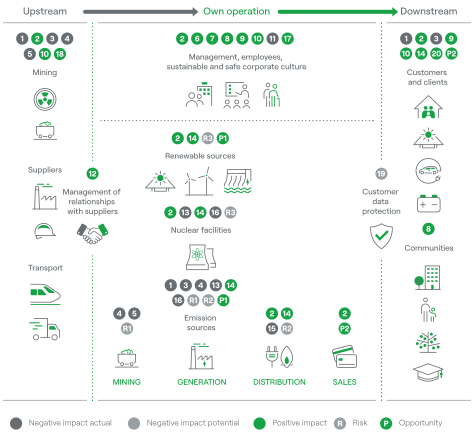
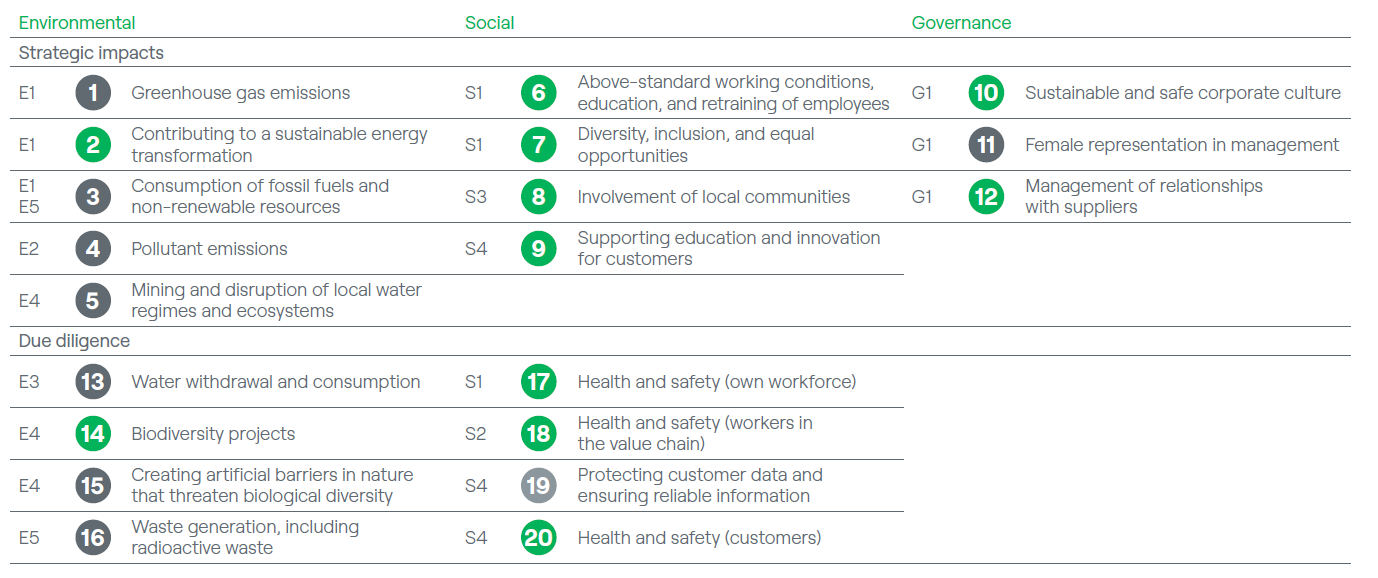
CEZ Group is required to disclose information on the double materiality assessment (DMA). The objective of this assessment is to identify and disclose information about material sustainability-related impacts, risks, and opportunities.
The process was participated by employees of CEZ Group, internal experts tasked with assessing impacts, risks, and opportunities in CEZ Group’s sectors and activities. In accordance with the ESRS requirements, DMA representatives participated in structured interviews and workshops that provided a comprehensive view of relevant topics, while the DMA process guarantors, usually section or company directors, supervised the entire process and controlled its progress. All assessments were linked to the existing management processes of CEZ Group.
A simplified model of material impacts, risks, and opportunities in the business model across the entire value chain that illustrates the interrelationships between financial and impact materiality and their integration into the sustainability governance process.